A Ghost Story.
A Brigg correspondent says that some of the inhabitants of Change Alley, Wrawby-street, Brigg, have lately complained of nocturnal noises, and one night they called in a policeman, stating that there were sounds as of someone running up and down the stairs. The officer on entering the house could neither hear not see anything to cause alarm, but his assurances did not allay the inmates’ dread of impending evil.
Suspicion was aroused that something was wrong in an adjoining unoccupied dwelling, which many years ago was a lodging house. Part of the floor of this building was dug up, and there were discovered a number of bones, some of which are said to be human remains, whilst about others there seems to be considerable doubt. People are now connecting the sounds with this discovery, and so terrified were one family that they have removed.
Manchester Evening News, 15th June 1901.
A story of things that went bump in the night.
Do you believe in ghosts? Most people say they don’t and come up with “rational explanations” like down-to-earth plumbing and building settlement when told about things that go bump in the night. Nothing to do with supernatural forces, they assert.
Two Brigg families, the Staples and the Wattams, accept none of these explanations as they recall their experiences at No.56, Wrawby Street, Brigg. Taken at face value, what the Staples have to say about what happened there in the early years of this century could be put down to over-imaginative children, perhaps frightened of the dark, inducing among themselves a feeling of panic. Except that many of what they describe as “strange happenings” are confirmed by an entirely unrelated set of people, the Wattams, who worked in those premises 40 years later. In many respects their versions are identical – “heavy footsteps on the stairs; the apparition of a little man in a cloak; the feeling that something was passing you on the stairs.”
Todd Dodd, former chief reporter on the Lincolnshire Times, whose offices in Wrawby Street adjoined the “haunted premises” has been testing the ghost stories, to see if they stand up to the passage of time.
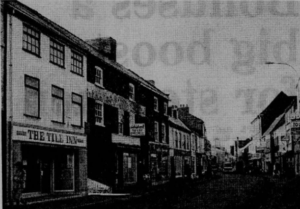
Wrawby Street, Brigg, showing the properties on the left reputed to have been haunted.
The Ghost Who Lived At Number 56.
For one of the Staples daughters, Marian, the experience was well over 60 years ago, but having spent the first 11 years of her life there, she says: “It was an evil house. I still have nasty dreams about it.” And Mrs Florence Wattam, who ran a fish and chip shop there for five years, says: “It was a horrible place. There definitely was something there, I don’t care what anybody says.” The significant aspect about what they have to say about “the ghost of No. 56” is that it does not have to rely on hoary legend which cannot be challenged. All concerned with this story are still living in Brigg. They talk freely, with no inhibitions. You may remain unconvinced, even disbelieving. They don’t care.
It was a story in the Scunthorpe Evening Telegraph announcing a change of use of the former Lincolnshire Times office that revived a mention of a “resident ghost” in that part of Wrawby Street. That prompted recollections of interviews of exactly 20 years ago, when the Staples and the Wattams spoke of the extraordinary happenings at the premises next door to the office. I wondered if their memories would have stood up to the test of time. Would they be as firm in their convictions in the cold light of January, 1987, as they were in February, 1967? I decided to talk to them.
I must confess I have always been a sceptic where ghosts and poltergeists are concerned. Now, having heard what they have to say – I wonder. There were stories current at the time that the ghost occasionally strayed into the Lincolnshire Times office, but I can say that during the 20 years I worked there, I never saw anything. Certainly there were odd noises – a door that would swing open on its own and creaks on the stairs which, with some imagination, could have been footsteps. Heads would be raised in anticipation of visitors who never arrived. Roof timbers did groan but this was an old building and we did have roaring coal fires in those days. That was the explanation I gave to a succession of young editorial trainees who evinced a degree of apprehension. As time went on, the noises became an office joke and the “ghost”, irreverently dubbed “Wally” became a supernumary member of staff. But, joke or not, those trainees never relished the idea of working there alone late at night.
Those who had lived and worked next door, however, had much more hair-raising stories to tell. No 56 was occupied in 1910 by a local fishmoger and bookmaker, Mr Tim Staples, his wife and family. Marian, one of several daughters, was born there in 1013. Today she lives with her husband, Mr John Kitwood, in a flat at Horse Fair Paddock, Brigg. Recalling her childhood days at the Wrawby Street premises, Mrs Kitwood said she always had the feeling that there was something uncanny about the place. “There were so many upsetting things that Dr Frith advised my father to move for the sake of the children. We left there in 1924 to go to a house in Albert Street.”
Even today, at 73 years of age, Mrs Kitwood said she still had nasty dreams about the things that happened there when she was a child. “I always had the feeling that something was following me on the stairs. One day I actually saw what it was. It looked like a little old man in a blue or velvet jacket and knee-breeches. This is what I see in my dreams. I panic and feel I must get past that first staircase as fast as I can.” Mrs Kitwood said there were other people who had seen the figure on the stairs. It was supposed to be the ghost of a Dr Abbott, who had cut his throat at the top of the stairs.
“We girls, – me, Evelyn, Viola and Maude – slept in a bedroom at the top of the house. We had two big brass bedsteads and one of them was pushed right up to a cupboard door on the wall. Sometimes we would wake up and find that this bed had been moved about a couple of feet into the room and the cupboard door would be open. We would hear footsteps coming past our beds during the night. We would never go to bed on our own.”
One night, said Mrs Kitwood, the family heard a tremendous crash and rushed upstairs, expecting to find the china cabinet in ruins. There wasn’t a sign that anything was out of place. In the kitchen was a set of service bells, the sort they used to have in “Upstairs Downstairs” days to summon servants. “Sometimes we would hear them clanging furiously although we knew there was nobody there. In fact, they weren’t even wired up. It couldn’t have been vibration because there wasn’t any heavy traffic in those days.”
There was the time her friend, Mrs Parker, arrived to play bridge. “I was going upstairs with her when I remembered something I had to do and had to go downstairs again. When I rejoined her on the landing she was as white as a sheet. She said somebody had followed her upstairs and she had felt a hand on her shoulder. When she looked around there was nobody there.” But the night she will always remember is the New Year’s Eve her parents went to the Bowling Club dance at the Angel Hotel. “My friend Dorothy Bains came to keep me company. We were all right until about midnight when we heard heavy footsteps on the stairs. We were petrified because we knew there was nobody else in the house. We ran outside into the street and stayed there, freezing, until they came home. I had a Pomeranian called Nettle. I wanted it to sleep at the foot of my bed but I could never get it to go upstairs, not even into the lobby. It must have been frightened of something. Father used to tell us not to be ridiculous and said we were imagining things but we noticed he always slept with a lighted gas jet in his bedroom.”
When the Staples left in 1924, the living accommodation was vacant for some time. Then Mr Staples let it to his daughter, Evelyn, and husband Jim Argent. They had two children, Stuart and Peggy. “Peggy would be about six when she came downstairs late one night and said a little man had brought her down. On another occasion, when Stuart was about eight, he called out that he wanted to be fetched down because he didn’t like the little man who kept coming to the side of his bed.” Mrs Kitwood said Evelyn was terrified. “Jim had gone to Mexborough market and she was alone in the house except for the children. She spent the rest of the evening at the shop door, waiting for Jim to come home.” Next morning, she said, Stuart described the little man as having a large lump on his back and wearing a brown cap. The family later moved to a house in Glebe Road.
Mrs Kitwood’s sister, Mrs Viola Rowbottom, formerly of Preston Drive, Brigg, is today a resident of Rosecroft, a local home for the elderly. At 89 years of age her memory is not what it was but in the 1967 interview she had much the same story to tell – with one exception. “To be honest, I never actually saw anything,” she said. Apart from that, her version coincided. “There was always the feeling that something was with us. A week would go by without us hearing anything. Then back it would come, the footsteps on the stairs, the rattling of cutlery in the drawers and strange knocking noises. It was all very frightening for us girls. Father used to say we were being ridiculous but for all his confidence he had a gas lamp burning day and night on the landing.” Mrs Rowbottom also mentioned the mystery of the moving bed. “That was frightening. We would all go to bed together and wait for one another in the morning.”
Another who remembers some of the strange happenings at No. 56 is Mrs Kitwood’s daughter, Mrs Janet Murphy, of Tofts Road, Barton-on-Humber. She recalled a visit to grandfather Staples when she was about 12 years of age. It was then that she saw “the figure on the stairs.” A phone call to Mrs Murphy produced the following off-the-cuff recollection: “Yes, I remember it distinctly,” she said, when told that her mother had suggested she might have a contribution to make. “I was going downstairs when I saw this shadowy figure coming up. I thought at first it was Peter Neall, who worked for grandfather at that time. Then I realised it was the figure of a little man. I seem to remember that I called out but he just disappeared. When I tell people about it they don’t believe me and say I’m stupid but I know what I saw. It was weird, frightening, something I shall never forget.”
The sceptics might like to compare the Staples’ stories with what Mrs Florence Wattam has to say. She and her husband, Coun. Jack Wattam, rented the premises in 1964 and started a fish and chip business, including a cafe on the first floor. Today, living at Highfield Grove, Brigg, Mrs Wattam says that although they left there nearly 20 years ago, she remembers every detail – and still has “awful memories.” “I sensed there was something odd about the place in the first fortnight I was there,” she said. “I heard a sound like shuffling feet and went to see what it was. There was nobody there.” Later she saw peas carrots and bread buns floating about; footsteps on the stairs and the sound of chairs being moved when she knew she was alone in the shop; knives and forks rattled in the drawers. “I didn’t say anything to the women who worked for me in case they thought I was looney,” says Mrs Wattam. “The time came when they began to tell me. Mrs Benson said she went to serve an old lady who was on the landing but when she got there, the figure disappeared. Another time we heard something upstairs, like plates being scraped. Sheila said she thought all the customers had gone but went to have a look. When she came down she said: ‘There’s nobody there.’ It got so nobody would go upstairs by themselves. They had to go in twos.”
“One night there were three of us at the pans and a big dripping knife came clattering right across the range. If the lids hadn’t been closed we would have been scalded with hot fat. Sheila’s husband came to see me and said she would have to leave, otherwise she would have a nervous breakdown. I know just how she felt. I nearly had one myself the night I saw the little old man come gliding out of the cupboard. It did glide, there were no footsteps. That’s something I shall remember for the rest of my life. The outline was like a shadow, as if it had been blown by a puff of cigar smoke. It was stooping and I couldn’t make out whether it was a fat old woman or a little plump man in a cloak. It had a round sort of hat, like an old-fashioned bowler, the colour of a nutmeg. The shop door was closed but this whatever it was floated straight through the door where the letterbox was.”
“By this time I had heard something about the ghost of a doctor who had died there and when the staff came in I told them that if they had come a few minutes earlier they would have seen him go through the door. I know what people say – a lot of them don’t believe me – but I know it wasn’t imagination. I really did see it. Nan Booth, who did the office cleaning next door, said she had often seen it come through the wall but she said it wouldn’t hurt you and she just carried on with her work. And Charlie Johnson, who married one of the Staples girls, told me ‘I believe you, love, I’ve often seen it.'”
There was the time when Jack had gone home to feed the dog and she was alone in the shop. Later she heard footsteps upstairs and thought it was Jack who had come back without her seeing him. “I put my head through the hatch and shouted: ‘Is that you, Jack?’ There was no answer so I shouted again. When I realised it wasn’t Jack and that it might be that little man again, I ran out and stood under the archway. It was snowing like billyo and I was freezing but I stayed there till he came back.”
Son John started painting a ceiling on a day the shop was closed. He fled when he heard footsteps on the stairs. He knew there was nobody else in the building and that the doors were locked. “He never did finish that ceiling,” said Mrs Wattam. “He said the hairs on the back of his neck stood on end. I paid Mrs Benson extra to stay while I finished it.”
Mrs Wattam was making the rounds one night with daughter Sandra, making sure that everything was in order before locking up. They put out the gas fire in the cafe and noticed that all the chairs were stacked under the tables. When they went back through the cafe after looking at other rooms, they saw a chair standing on its own in front of the fire. “Sandra noticed the chair and couldn’t get downstairs fast enough. She never went up there again. We had a dog who wouldn’t go upstairs. It used to howl so much we had to take it home.”
Throughout all this, Jack Wattam remained unconvinced – until the time his afternoon nap was rudely shattered. “I was fast asleep in an armchair when I felt it rock and tip as if somebody was trying to shake me out,” he said. “I was thrown nearly halfway across the room. It was then that I believed what the women had been saying.”
Last word from Mrs Wattam: “I had never heard about this Dr Abbott until some time after we had taken the shop. When I started talking about what was happening, Marian Kitwood agreed with me. If I had known about it earlier, we would never have gone there. I have some awful memories of that place and I would rather sleep in the street than sleep there. I wouldn’t go back again for all the tea in China.”
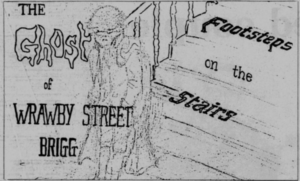
An artist’s impression of the Wrawby Street ghost, drawn by Ann Jeffrey, based on a line drawing by Marian Kitwood. Now 73 years of age, Mrs Kitwood says she still has nasty dreams about “the figure on the stairs.” She dashed off a sketch of the ghost in a few seconds.
Scunthorpe Evening Telegraph, 3rd February 1987.
I saw the Brigg ghost.
I was pleasantly surprised to receive a page of the Scunthorpe Evening Telegraph dated February 3 and read the article headed “The Ghost who lived at Number 56.” I am the Stuart Argent who saw the ghost of Dr Abbott, but I saw him on a number of occasions, usually on the staircase or on one of the landings.
I was born in the top room where my mother and aunties used to sleep. There were further disturbances, the sound of a piano being played in the rooms next door, usually about 2 am. Yet when we mentioned it to Mr and Mrs Allan who lived there (painter and decorators), they hadn’t heard anything. Yes, they had a piano in the middle room, second storey, but no one knew how to play it.
In the back yard was a large wash house where a man was found hanging. In the kitchen was a very deep cellar where my Grandad kept newspapers for his fish business – but he always sent my mother to get them as we heard bumps and rattling in there, and as down to earth as old Grandad Staples was, he wasn’t game to go down there.
I remember during the war, I went down. I was then a Grenadier Guardsman and I got out there as quick as I could. My flesh crawled and my hair stood on end. There was a feeling of deep evil in there.
The ghost never gave one the feeling he would harm you, but I think that when a new family moved in it became vindictive. They say that ghosts grow used to the same family, but when this changes they take over a poltergeist role, as Mrs Wattam’s experiences show.
I don’t know if the present tenants experience anything, but in your picture it has been altered considerably, although the premises next door and the archway look much the same. It was always a fish shop, or fish and chip shop until just after the war. As a matter of interest, the black American troops made it a Mecca in the war because they loved the food and my mother, who served in the shop, treated them as her boys – so different from their treatment in the USA. They couldn’t get over the equality of white and black, especially in Brigg.
Hope this has been of interest. Salute to all my Brigg friends. – Stuart Argent, West Ulverstone, Tasmania, Australia.
Scunthorpe Evening Telegraph, 3rd March 1987.
Priest calls an end to flat’s ghostly goings-on.
A century-old ghost may be haunting a Brigg flat where the two tenants have called in a priest after a series of “unexplained happenings”. These include: A cascade of water streaming down an interior wall; A cassette which went haywire and tuned itself into the radio; An unusual spell of the telephone going on the blink despite an assurance from British Telecom that the line was in perfect order; And, most unnerving of all, a ‘horrible groaning noise’ in the middle of the night.
Two girls who share the flat had read the story of the ghost that was said to have haunted No. 56 Wrawby Street and the adjoining premises – the former offices of the now-defunct Lincolnshire and South Humberside Times. One of them, Nadine O’Neill, moved into the refurbished flat about five weeks ago. Everything was normall until she was joined by friend Rachel.
“When I saw water streaming down the wall I thought there must be some flooding from the flat upstairs, possibly a tap that had been left running,” said Nadine. “I went upstairs to enquire but there was nothing there that could have caused any flooding. When I came down again, the wall was quite dry.”
It was that unearthly groaning in the middle of the night that proved to be the last straw.”We were both terrified and on top of everything else that had been happening, we seriously thought about moving out. Then I thought about getting a priest in,” said Nadine.
Fr. Roger Maher, of St Mary’s, recited prayers and blessed the house, leaving the girls with a crucifix and holy water. This week the girls said that peace had been restored at the flat. There had been no untoward incident since Fr. Maher’s visit.
No. 56 Wrawby Street has long been associated with the ghost of a certain Dr. Abbott, who committed suicide on the premises.
Grimsby Daily Telegraph, 25th June 1994.