About a hundred years ago, there lived in a cottage, still standing, nearly opposite the old Friends’ meeting-house at Sidcot, a real Conjurer of the old school. His name was Beecham, and he had a wife whose name was Joan. He had the reputation of being a great “medicine man;” had a magic staff and books, wore a red cap, and was consulted as conjurer, or cow-doctor, whenever dryness in pump or cow, or loss of appetite in sow, disturbed the farmer’s peace of mind. The time came at last for the wizard’s staff to be broken, and his books to be wound-up. In view of the grave, he insisted on being buried under a certain tree in his own garden; telling his wife, if his directions were not complied with, “I’ll trouble ‘ee.” The mortal clay, however, when vacated by the conjurer, was decently buried in the churchyard; and the widow, diligent, not disconsolate, remained in the old cottage, earning her bread by making cakes and sweets for other people. Thus she lived till she died, no one ever finding her cakes bewitched, or her sweets turning supernaturally sour. She lived and died with the character of a plain, honest body – a good old soul.
But now for the marvellous part of the story. On the anniversary of the old conjurer’s death, or burial, tradition has forgotten which, one Wednesday morning, when the Friends were sitting in solemn silence in their usual week-day meeting for worship, their meditations were interrupted by the sudden appearance – not of Beecham’s ghost – but of the woman who lodged with his widow, and who took care of the meeting-house. Pale with fright, she cried, “Oh Friends, do’e come out; there’s all Joan Beecham’s things a vallen’ about the ‘vloor.” Two Friends, one a Minister, the other an Elder, solemnly rose and left the room, probably thinking more of preventing further disturbance of the meeting than of meddling with disturbance elsewhere. However, they followed the doorkeeper to widow Beecham’s, and there witnessed a kind of disturbance they had never seen or heard of before.
As they entered, a heavy, old-fashioned chair came to meet them; pots and pans were flung violently about; old Joan’s heavy pastry pan rocked up and down as if moved by invisible hands. The Friends were shrewd experienced men, with a full share of the sobriety and worldly wisdom, if not spiritual discernment, with which their Society has always been credited. They were not likely to be taken in by the trickery of two old women; but they could discover no imposition; nor could they ever explain or account for what they had witnessed.
The facts are undeniable. The report of the occurrence spread in the neighbourhood, and many persons visited the spot to inquire into the circumstances. Amongst others came Hannah More, but neither her superior sense and learning, nor the sagacity of commoner people could unravel the mystery.
The conjurer never troubled the widow again, and the occurrence gradually subsided into the general collection of ghost-stories. And so it might have remained, had not later experience caused some re-action from the general contempt for alleged supernatural occurrences. Cases very similar to that at Beecham’s cottage are said to be not unfrequently witnessed in “table-turning” circles; and though such reports are sneered at by those who have not witnessed them, their sneers are in turn smiled at by those who have. Sneers, however, prove nothing one way or the other. The facts are attested by too many respectable witnesses to be disposed of in that way. They are admitted by many scientific men, and various theories have been stated to explain them.
These theories, however, are little more than a classification and nomenclature of the phenomena. Mesmerism, which was decried as imposture fifty years ago, is now, under the more scientific name of hypnotism, deemed worthy of some examination. We now hear of animal magnetis, psychic force, unconscious cerebration, levitation, and so on; but how the psychic force and unconscious cerebration of the widow Beecham could have caused the levitation of her kneading-troubh, and her late husband’s heavy armchair, remains as much a mystery as ever.
A less scientific theory has been offered in this particular instance. It is suggested, as the conjurer had threatened his wife to “trouble” her on the return of the day of his decease, or burial, that possibly his conjuring crew – for it is assumed that he was in league with others – might for the credit of magic in general, and their late confederate in particular, have planned a scheme for fulfilling his threat. But this supposition leaves the mystery as great as ever; for if the movements of the pans and chattels were effected by mechanical means, no uncommon sight and shrewdness could be needed to discover them. It is said that professional jugglers do more wonderful tricks. Perhaps so. But who was the juggler here? Where was he concealed? And where was his apparatus? Where were the wires, and who were the wire-puller? A little stone-floored cottage can hardly be compared with a theatre expressly arranged with stage and machinery for organised and avowed deception.
[,,,]
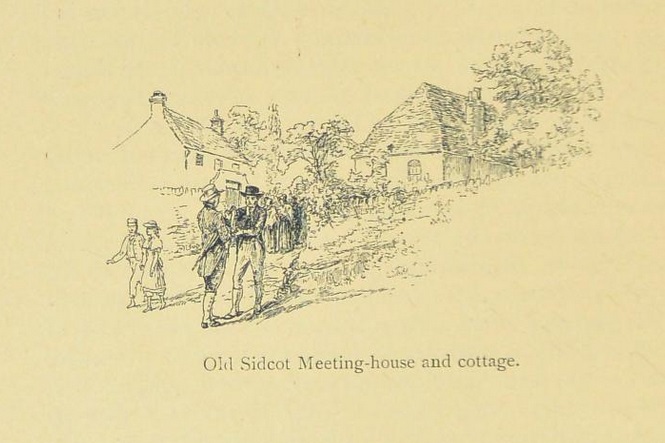
From ‘A Mendip Valley’ (1892) by Theodore Compton.
The old Meeting-house of 1718 and the more northerly of the two cottages which are divided from it by the steep and narrow lane called Harborough Batch were the scen, less than twenty years before the foundation of the School, of a remarkable occurrence, whose details, whether due to supernatural agency or to mere trickery, have never been explained, and upon which is founded the Sidcot ghost-story.
The house across the lane was the residence of a man called George Beacham, a man who passed in the district not only for a cattle-doctor, but a conjurer. Tradition even credits him with wearing a red cap and with the possession of a wizard’s staff and magic books. When he was at the point of death he told his wife to bury him, not in consecrated ground, but at the adjoining four cross-roads, so that as he lay in his grave he might have the amusement of watching the passers-by. “If ‘ee don’t,” said the old man, “I’ll trouble ‘ee.” This last request of his was not complied with, however; and on “July ye 27 1788,” as we learn from the Parish Register, his ashes were laid in Winscombe churchyard.
A year went by. And then, one Wednesday morning, the 22nd of July 1789, twelve months, apparently to the day, after the old wizard had departed his life, while Friends were sitting in Meeting, John Benwell’s boys among them, a terrified woman, a woman who lived with the Conjurer’s widow, and who also, it is said, was care-taker of the Meeting-House, came rushing in, and broke the solemn stillness by crying: “Oh, neighbours, do ‘e come! Here be all Widow Beachm’ things a-vallin’ about the vloor!”
Two Friends, John Benwell and Charles Strode, got up, walked quietly out, crossed the lane to the Beacham cottage, and saw, so the story goes, chairs and tables, pots and pans dancing about the room, and the kneading-trough which the widow used in making the cakes which she sold in her little shop, rocking to and fro, as if moved by invisible hands. More than that, the astonished onlookers saw the dead man’s boots clattering slowly downstairs into the kitchen. The two Friends looked and wondered. They could find no solution of the mystery. The disturbances had not ceased when Meeting broke up, and other Friends came across to see what had happened. Among them was John Benwell’s daughter Hannah, – who subsequently married Arnee Frank. Long afterwards she used to describe how, as she entered the cottage kitchen, she had to avoid a large and heavy arm-chair that was moving slowly across the room.
Hannah More, whose labours among the Mendip miners began in the very year when this happened, is said to have driven over from Cowslip Green at Wrington to inquire into the circumstances. And the “favourite Mr Jones” of Mendip Annals, then curate and afterwards rector of Shipham, and who taught French in John Benwell’s School, also visited the widow Beacham’s cottage. But neither they nor any other inquirers could determine whether the disturbance was caused by the unquiet spirit of the disappointed necromancer, or whether it was merely the result of trickery. Trickery there may have been, but there was no evidence of it; nor, indeed, does it appear that there would have been any object in trickery; and no explanation was then, or at any later time, forthcoming. Jone Beacham, as her name is spelt in the Burial Register, survived her husband nearly six years, dying in January 1794. But he did not trouble her again. It was the Conjurer’s last trick. The strange performance appears never to have been repeated.
From “A History of Sidcot School: a hundred years of West country Quaker education, 1808-1908” by Francis A Knight, 1908.
Ghostly goings on up at the school…
Poltergeists and rebellions are not things that automatically spring to mind when you think of a Quaker school. But Sidcot School, Winscombe, has some surprises hidden in its past. And its colourful and often off-beat history has haunted and inspired its outgoing headmaster, Dr Chris Greenfield, to write By Our Deeds – Some Tales of the Slightly Unexpected from the Quaker School at Sidcot. […]
Chris Greenfield writes: “The Sidcot ghost is one of the most extraordinary stories associated with the early days of the school. So fantastic were the events of July, 1789, that the story has leapt from the pages of the Sidcot history books into the folklore of Somerset. In 1990 a new light was thrown upon the story when Christine Gladwin, a teacher at Sidcot, discovered a bundle of documents in the school archives…”
The envelope she opened appeared to have been sealed for 150 years. It contained hand-written, eye-witness accounts of supernatural happenings. Mystical cattle doctor George Beecham lived in a house opposite the old Meeting House. He told his wife that, on his death, he wished to be buried under a tree in his garden, which offered a good vantage point of passers-by. And his last request was coupled with a threat: “If ‘ee don’t, I trouble ‘ee.” He was buried in St James’ Churchyard, in the village.
On the anniversary of his death, his widow Joan burst into the Quaker meeting on Wednesday morning, saying all the things were being thrown around in her house. Masters dashed over to witness what was recorded as a scene of supernatural occurrence, as chairs and tables, pots and pans danced round the room, a pail of water overturned and bedclothes were hurled from the bed. The vicar was asked in to perform an exorcism and “could not determine whether the disturbance had been caused by trickery, or by a visitation of the unquiet spirit of the disappointed necromancer.” […]
Shepton Mallet Journal, 7th August 1997.