Seeing things… by M.F. Everett.
Priest and Poltergeist.
‘The Priest and the Poltergeist’ the case could be titled. It is a real life mystery. And the poltergeist, impish “noisy spirit” that it is, was the winner in the early rounds. The priest, however, was not perturbed. “But if it is a ghost or poltergeist” responsible for the strange happenings, he hoped “it doesn’t come over to the rectory.”
The happenings started Jan. 3 in a 125-year-old farm house belonging to Mr and Mrs Frank Ehrhardt, who have lived there since 1949 when Mr Erhardt retired as a New York city policeman. The house never had a history of strange events. But it has one now. Mr Erhardt cannot figure out how, for instance, his shaving brush could move from the bathroom to the hall floor three times – and then disappear. Nor can he fathom how a bar of soap became crushed in the hall, how sticks of gum traveled from the kitchen cabinet to the table, or why the toaster, stove and furnace all failed at the same time.
The Erhardts are Protestants. But his sister keeps house for Father Hector O. LaMontagne, pastor of Our Lady of Lourdes parish, Pittsfield, N.H., not far away. She asked him to bless the Erhardt house. “It started out as a natural thing, something I do all over, just a blessing for relatives of my housekeeper,” the priest said. But then he was confronted by all “these strange little things, like gum and candy seeming to fly through the air.” The priest himself saw one of the unexplained occurrences – a piece of candy apparently moved from one room to another without visible means of locomotion. He reserved judgement on this. But he included a “little extemporaneous prayer” for exorcism as he blessed the house. “Evidently it wasn’t very effective,” he said. He jokingly admitted that his impromptu exorcism probably would not have “worked” anyway because poltergeists are not really evil spirits. “They’re just bothersome, not really bad.”
Poltergeist, from German words for noise and spirit, refers to “some type of force to which is attributed a set of spontaneous, puzzling, and troublesome occurrences,” says the New Catholic Encyclopedia. “These take the form of noises, self-propelled stones, the popping of bottle caps, and the like. Apparently these occurrences are never dangerous to persons, but they are perturbing and frightening.” Poltergeist phenomena occur for no obvious purpose and on no special occasion. Their completely unpredictable character makes them hard to investigate scientifically.
Poltergeist activities differ from a case of diabolic possession in which a human person usually is possessed or obsessed. A poltergeist “force” remains aloof and does not affect human beings directly. The phenomena also differ from cases of “haunted houses.” “Hauntings” are long lasting and threatening. Poltergeist incidents are relatively short and are of a mischievous nature. The popular belief is that they are the work of a “playful ghost.” The phenomena have been known since primitive times. Most reports of such happenings can be discredited for one reason or another. But careful study indicates that there often is definitely something in operation that cannot be explained by normal physical causes.
A technical hypothesis points to psychokinesis, the moving of objects by the influence of the subconscious mind without bodily intervention… mind working on matter. Usually the phenomena occur in a house where there are children, though this is not the case with the Erhardts. An “agent” usually is present, most often an adolescent, who does not perform the acts but serves as a “medium.” Some believe the influence can be exerted unconsciously by unduly strong wishes on the part of a person at a distance.
Mr and Mrs Erhardt remained relatively calm about the happenings. His sister refused to stay in their house. Father Montagne was getting all sorts of advice about how to deal with the spirit world. And as objects flew about at random the poltergeist probably was laughing up its ghostly sleeve.
The Clarion Herald, vol. 8, no. 47, 28th January 1971.
Pittsfield Poltergeist House Revisited for Halloween 1976.
By Deborah De Peyster.
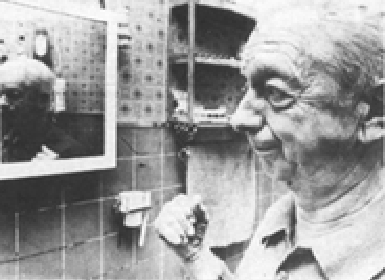
Finding peanut shells between the bed sheets that wintery January night was strange but explainable. Perhaps it was the work of a squirrel or chipmunk. The shells appeard in the bathroom sink the next morning. Coming downstairs to breakfast, the couple noticed a bar of soap crushed at the foot of the stairs and a bar of soap on the piano. As guests in the house of their aunt and uncle, Mr and Mrs Frank Ehrhardt, the couple found the events curious and slightly strange.
The Erhardt’s waking that same morning found more things that had gone slightly awry. Pills from the bathroom cabinet were spilled on the floor, but the bottle tops were still in place. Erhardt’s shaving brush left its holder on the bathroom mirror and was found on the floor. The brush repeatedly refused to occupy the space in which it had remained motionless for more than 20 years before.
The thermostat kept jumping up to 90 degrees. When Ehrhardt finally yelled, “Now you stop that, this is costing me money,” it stopped. The bathroom air freshener spouted lilac mists for no reason at all. Gathering for breakfast that morning was disconcerting. The toaster didn’t work, neither did the stove, oil furnace and all of the cars. Those were only a few of the unexplained happenings at the Ehrhardt’s 129-year-old farmhouse Jan 3. and 4, 1971.
“How did they happen, can you tell me?” the 71-year-old Ehrhardt asked frequently while sitting in the kitchen Wednesday night with his wife Jeannette, a reporter and a photographer. The couple reviewed the events of 1971, and told how most of the happenings ended as mysteriously as they began. They laughed good naturedly about the antics of what they now refer to as Stanley the mischievous poltergeist. The reporter and photographer didn’t laugh as heartily. Their eyes were roving, and at the slightest fluctuation of light or sound they would flinch just a bit. The Erhardts told their story late into the night.
Approaching the Ehrhardts’ house, the road turned to dirt and went up a hill. It was clear and cold Wednesday night, and the sliver of moon was bright. A knock on the door produced first the face and then the figure of Frank Ehrhardt, and the house light turned on. Entering the glassed-in porch, I noticed a clock whose hands were stopped just past midnight. Heading into the kitchen, I saw what looked like a black, shrunken head with long black hair hanging on a wall. Don’t over-react, I told myslef.
A quick tour of the house with Mr and Mrs Ehrhardt put me at ease. They chatted incessantly and the house was warm, friendly and colourful and with many plants. There was nothing to be nervous about, I said to myself.
“Did you tell her about my hair curlers, Frank?” asked Mrs Ehrhardt. Ehrhardt told the story. Mrs Ehrhardt had set her hair in curlers early the morning Jan. 3, 1971, anticipating an evening out. She forgot about them in the hubbub of activity until her husband asked her where they were. The pink, spongy rollers were no longer in her hair, and she didn’t take them out, she said. Later, Ehrhardt found them in a flower pot. The pin clips around the base of Mrs Ehrhardt’s neck were found in the bathroom toilet.
News of the strange happenings traveled fast. Reporters, photographers, Ouija board experts, and seance mediums flocked to the house. Letters offering advice came pouring in. Invite the spirit to dinner, said one. Cook it spaghetti and meatballs, put the meal in a dark corner and it will become gold, said another letter writer who also wrote that the ghost really was a leprechaun.
And strange things kept happening. A photographer put a fresh roll of film into his camera, took pictures of the house, then returned to his darkroom to find no film at all. Other photographers have had trouble getting the shutter of their camera to click when taking pictures of the house, Ehrhardt said. A reporter, taping an interview with the Erhardts, pushed the playback button and heard a young girl’s voice, nothing more. For a few winters, the man who plowed their road wouldn’t do the job, Ehrhardt said. Every time he turned into the driveway, the windshield wipers and headlights would flash on and off for no reason.
“It’s hard to explain, there’s no answer to it. It doesn’t bother me that much, although I hope that maybe somewhere, somehow we might get an answer,” said Ehrhardt, a retired New York policeman, in his heavy Brooklyn accent. “Anything is possible,” his 67-year-old wife said.
Bedtime was fast approaching as they spoke and the reporter, who planned to stay the night, was becoming noticeably nervous. “I saw you look over there. What did you see?” asked Mrs Ehrhardt about the reporter’s glance to the kitchen window. “You won’t see anything,” Ehrhardt said. “It came and it went, why I don’t know, I’ve never figured it out,” he said. But he was confident it wouldn’t come back. They don’t miss Stanley and “welcome him back if he wants to come,” Ehrhardt said.He said it won’t come back, I repeated to myself as I climbed the stairs to the second floor bedroom. I pulled down the sheets of a large double bed and tried to keep myself from looking for peanut shells. Alone in a large room with several beds of varying sizes and a large yellow teddy bear staring at me from across the room I tried to sleep. The house was very quiet, and I tried not to hear anything. I pulled the down sleeping bag up around my ears, and although the house was heated to about 70 degrees, and I was sweaty hot, I refused to move.
2 a.m., still quiet. I don’t think I’ve slept. Why did the bed move? It was nothing, just my foot twitching and hitting the frame of a bed that is too short, I told myself. 6 a.m. Finally I think it’s time to go to work. Outside, I got my first glance at the house in daylight; white with black shutters, an imposing sight on a sloping hill marked by only three large leafless trees. The horizon in the distance is brilliant red. In my car I breathe a sigh of relief and headed toward Concord.
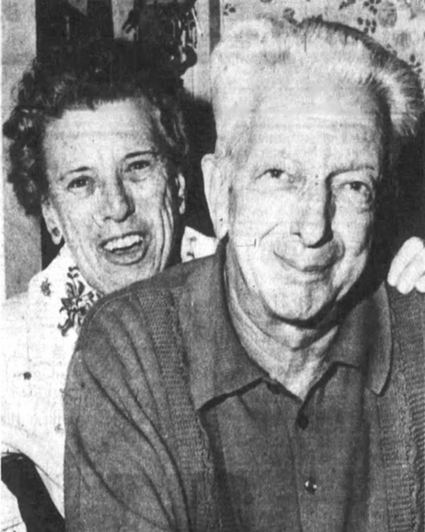
Photo by George Newton.
The Concord (NH) Monitor, 30th October, 1976.