“Ghost” at Coedkernew.
Extraordinary happenings at Mardy Farm.
Walking bacon and stalking beds.
A wonderful clock.
Coedkernew has got a “ghost”. It is no common or garden spook, and if only a half of its reputed doings are true, there will be no holding this latest restless rover from the other world when it decides it can, with a clear conscience, return to rest, for it will have put to utter and everlasting shame those poor unoriginal spirits who could devise no other amusement than the stately stalking of the corridors of ancestral mansions to the accompanying music of the clank of chains.
The Coedkernew ghost is a modern ghost. Its parents must have sacrificed the blue blood of nobility for the spirit of commercialism. It does not believe in heaving heavy sighs and moaning plaintive ghostly airs; indeed, the Coedkernew ghost is quite a common ghost. It will probably find itself unmercifully snubbed by the ghosts of past ages, for what self-respecting ghost of a nobleman would dream of associating itself with a ghost who contented itself, when on earth, in dealing in bacon.
To turn from the contemplation of the troubles the Coedkernew ghost will have to face, to the stories which have thrilled the entire neighbourhood of Coedkernew; and have provided a theme of conversation for every household between Castleton and Newport, Saint Brides, and Risca, it is necessary first of all, to describe the place where this spirit from the unknown has decided to stay during its visit to the earth. The house it has honoured is the well-known Mardy Farm, belonging to Mr E. Parsons, and the choice has given the ghost plenty of room, for Mardy farmhouse is spacious, and lies on the right of the road leading to the Stud Farm of Lord Tredegar.
It came to earth last Friday night, and announced its presence in rather a strange manner. Of course, one could hardly expect a ghost to walk up to an ordinary mortal, shake hands and make some such observation as “Hulloa, old chap; glad to see you. Been to sleep for three hundred years, and thought I would like a turn on earth. So looked you up.” No ghost could do a thing like that. So the Coedkernew ghost, with a little respect for past observances, made its arrival known by turning several pictures with their faces to the wall. Mr and Mrs Parsons were out at the time, and even when they returned the fact that a ghostly visitor had paid its ghostly call did not at once strike them. Some servant, or one of the children had done it, they said, but the servants said “No,” and the children said “No,” and the household began to think there was something the matter.
The exact sequence of things is not easy to get hold of. Mr and Mrs Parsons do not wish the stories of ghosts to go any further, but their efforts to stop the stories which are abroad have been quite futile. Either there is something in them, or their originator has missed his vocation, for a second Louis de Rougemont has come to earth. At any rate, one of the first stories which gained currency was that Mr Parsons came into Newport to buy a piece of beef. He took it home and placed it on the kitchen table. He then turned away for a moment, and when he looked again the piece of beef had compressed itself into a pint jug. Now that’s not a bad bit of work for a ghost! Perhaps it’s an advance agent for the sale of Bovril. Mr Parsons did buy a piece of beef, but it was nearer 14lbs than seven, and it did disappear; only the disappearance was due to the desire to satisfy the demands of “Little Mary.”
The next story has to do with the feeding of the cows in the stalls. Someone put down a bundle of hay, and the next minute saw it in the middle of the yard. There are two explanations for that, either it was a windy day or the ghost is a meddler in trifling details.
Then the ghost is said to have shown an interest in crockery. Two hundred pieces hanging in the kitchen dropped on to the floor. They did not break. “Old Moore” may find in this an omen as to the future of China.
But the fact which shows the ghost of Coedkernew to be a plebian, a low-born fellow, a veritable bungler in matters ghostly, comes now. Two sides of bacon hanging on the wall slowly come down from their rails, walked along the floor, and then crept up the sides again to replace themselves upon their hooks. Clever pieces of bacon! If it had only been gorgonzola cheese one might have been tempted to believe in the possibility, but bacon, solid uninspiring bacon! Mr Parsons has two pieces of bacon in the house, only they were in the pickling jars, and he suggests that the salt which is in the flitches might well be used when the stories are repeated. We quite agree.
Mrs Parsons – this is another of the stories – cooked four pieces of meat for two labourers, and put two pieces each on both plates. Then she went to call the two men, and when they came in, only one piece of meat was to be found on each plate. After a search the other pieces were found locked in the cupboard. What a funny ghost.
Rumour goes on to say that all the farm hands have left in consequence of the happenings in the house. One boy said he “woan’t going to stop when his bed galloped around the room at night. No blessed fear!” Talking about beds, the latest story is that during last night all the beds in the place started to walk downstairs; that they jammed in the passages, and, finding the effort useless, returned to their places. If the ghost cannot arrange matters better than to jam the beds in the passages, he, she, or it, had better give up the business.
Amid the many other stories is one of a clock which has stopped for three months, suddenly striking the hour, and then relapsing into silence. Rumour does not say whether the hour it struck was midnight. Little girls have gone to school telling how the pictures and the crockery on the walls are “going round as fast as they can.” Had those little girls been little men who had not very strong heads one could better believe that they had seen “things going round,” and blue snakes crawling up a pink and green loaf of bread might have been thrown in without exciting comment.
Probably by the time the reader has got down as far as this he will begin to have a suspicion that the things above recorded may not have actually happened. Whether they have or not does not alter the fact that such stories are in every mouth throughout the whole of the district. As a matter of fact there is no doubt that sufficient has happened to give a ground for the building up of such stories, and the turning of the pictures on the wall last Friday is an undoubted fact. The question is whether a servant or an ex-employe has not been playing pranks, and colour is lent to this view by the disappearance of the keys of the house one day last week. Still the household have been affected by what has gone on, and when the Vicar of Castleton was at the farm last Sunday they told him what had happened. A piece of bacon was lying on the floor, and there was no visible means of explaining its presence in such an unusual position. The local police were called in, too, and they favour the view that new bolts and locks upon the door will result in the stopping of the incidents which have caused such a sensation. As the Vicar told them, “If people believe in ghosts they must believe they come from heaven or hell. They would be too happy to wish to leave heaven; and if they are in the other place they would be too bad to let out.”
South Wales Weekly Argus and Monmouthshire Advertiser, 16th January 1904.
“Ghost at a Farmhouse”
A Village Scare.
Inhabitants of Coedkernew, a village pleasantly situated between Newport and Cardiff, are greatly agitated by the stories of a ghost which is said to have taken up its quarters at Mardy Farm, in the occupation of Mr. Ernest Parsons. It made its advent (according to a correspondent) by turning several pictures. Next day someone put a bundle of hay in a cow-shed, and by some mysterious means this bundle transported itself to the middle of the farmyard. The spook then turned its attention to the crockery, and two hundred pieces on the kitchen dresser fell upon the floor with a terrific crash. Mrs. Parsons cooked four pieces of meat for two labourers, and put two pieces on each plate. Then she went into the yard to call the men, and when they came to dinner the beef had mysteriously vanished. It was subsequently discovered in a locked cupboard.
It is further asserted, as showing the strange happenings at this haunted homestead, that two flitches of bacon hanging on a wall dropped to the floor while no one was near them. Rumour states that the farm hands are so scared that some of them have left the place. One little fellow declared he “woant going to stop when his bed galloped around room at night.” Another story which is current in Coedkernew is that the clock, which had stopped for three months, suddenly broke its silence and struck the midnight hour. When the vicar called at the farm he was shown the pieces of bacon, which were lying on the floor. The vicar was candid. If people believed in ghosts, he said, they must believe they come from heaven or hell. They would be too happy to leave heaven, and if they are in the other place they would be too bad to be released.
The local police, says the writer, have not succeeded in running to earth anyone who could satisfactorily explain these strange happenings. The villages might possibly be reassured if the vicar would read to them the “ghost” story in Mr. Barrie’s book, “A Window in Thrums.”
London Daily News, 16th January 1904
The “Haunted” Homestead. Extraordinary Stories.
Our Newport (Mon.) Correspondent telegraphs:
Evidently there is no abatement int he interest created by the strange doings of the Coedkernewe “spook.” Advantage was taken of the fine day by a number of persons yesterday to visit Mardy Farm, which adjoins Lord Tredegar’s noted stud farm, and is situate on his lordship’s estate. The rooms of the homestead are commodious, thus giving “the ghostly visitant” plenty of scope for operation.
Inquiries made at Coedkernewe yesterday elicited the fact that the “manifestation” had to some extent ceased, though uncanny things are still happening to disturb the wonted peaceful serenity of Mr. Parson’s household.
The family has been alarmed by mysterious tappings in some appartments. A story circulated in the locality is that one night all the beds started to walk downstairs, and that they became jammed in the passages. Two children indulged in stories of pictures and crockery going round as fast as possible.
Farmer Parsons himself scouts the idea that these alleged extraordinary happenings are the work of unknown “spirits.” He does not believe in ghosts, and his view is that someone has been playing pranks. There has been a strange disappearance of the keys of the outer door, and that tricks are being played seems to be indicated by the fact that these keys have since been replaced in their accustomed positions.
Our correspondent learnt from villagers who had passed the farm buildings during the night that there had not been anything unusual, though one yeoman declared that on his way home one night last week he saw a white object near Tredegar Park.
London Daily News, 18th January 1904.
Coedkernew in a state of alarm.
“Spook’s” pranks in kitchen and bedroom.
Coedkernew is a tiny village situate about four miles to the westward of Newport. An alleged ghost has been startlingly active there during the past week or ten days, and, as a consequence, the whole countryside has been in a ferment of excitement and consternation. As soon as the shades of night have fallen the women folk for miles around have resolutely remained indoors affrighted, and scores of men, sturdy sons of the soil, who would laugh at any human foe, have likewise declined to venture forth in the darkness. The uncanniness of the happenings at Mardy Farm has been so astounding that it has caught all the inhabitants on the Tredegar Estate between Newport and St. Mellon’s in its grip. Many scoffers there have been, ’tis true, but more believers. No common spook is this mysterious visitant; it is original in its methods, and has eluded all efforts at capture.
Coedkernew’s ghost came to earth about ten days ago, and announced its presence by turning several large pictures with their faces to the wall in the rooms of the farmhouse. Mr. Edwin Parsons, the tenant, and his wife were out when this strange episode occurred. Neither the servants nor the children could be induced to confess to the prank. Rumours of the ghostly visitation soon got about. Mr. and Mrs. Parsons have sought to check their winged flight, but in vain; and during the whole of the past week weird stories have increased and multiplied with a facility which does credit to the vivid imagination of Mr. Parson’s neighbours.
It is asserted, for instance, that a piece of beef was placed on the kitchen table by Mr. Parsons, who turned away for a moment, and when he looked again, lo and behold! the piece of beef had compressed itself into a pint jug! Then it is related that another day Mrs. Parsons prepared the dinner for two labourers. She placed two pieces of meat on each of their plates, left to call the men, and when she got back there was only one piece of meat on either plate. Both Mrs. Parsons and the labourers were greatly alarmed. They instituted a search, and found the missing morsels locked in a cupboard. One of those farm hands is said to have thrown up his situation and decamped in a hurry a morning or two later because of certain strange movements of his bed during the night.
Mr. Parsons lodged a complaint with Police-constable Cook, the guardian of the peace at Coedkernew, whose manly nature prompted him to reply that a horse-whip was needed more than the police at Mardy Farm.
Last Wednesday night a dozen young fellows from Castleton determined to watch during the night at the farmhouse. Nothing, apparently, occurred, but in the morning, although the stable-door was locked, all the harness was found turned out into the yard. Another story is that the name of Mrs. Parsons’ first husband, “Henry John Parsons,” was one day found written on the pantry window. Then it is stated that one evening the children came scrambling downstairs shrieking, followed by their bed. The best imaginative effort of all, however, is that told as to an incident at the end of the week. It was late in the evening when one of the beds was seen walking downstairs. It came half-way, and then turned round and walked back again!
One of our reporters called at Mardy Farm on Sunday. He attempted to interview Mr. Parsons, but the farmer was as silent as a sphinx. He could be induced to tell nothing of the happenings in his household. All the stories related were gleaned from other residents in the neighbourhood. We will not vouch for their accuracy. Indeed, we are inclinded to think that the neighbours, like the ladies in the time of Dr. Johnson – and at all other times – are in the habit of embroidering their facts. One outspoken sceptic was found in the village. “It reminds me,” he said, “of the days of my youth. I worked at a farm in this neighbourhood then, and a maidservant engaged there was a caution for practical joking. She forewarned me of one of her pranks. One beautiful starlit summer night, after work was done, the other labourers and I were sitting out in a field chatting and smoking, when we saw an object in white advancing towards us. Everyone scampered to the house for dear life, and one of the younger men, fleeter of foot than the others, came running back with a loaded double-barrelled gun. ‘I’ll shoot it! I’ll shoot it! he exclaimed; but I knocked the gun from his hands, for I knew it was Mary.”
Evening Express, 18th January 1904.
That Mardy Ghost.
Who threw the butter?
The Poltergeist, if we remember rightly, is a noisy, impish spirit, who amuses himself with upsetting everything in a house, throwing stones, and other naughty ways. So, at any rate, says one of the authorities on ghosts, and the reminder may be useful to the good people of Monmouthshire whose peace has been of late disturbed by mysterious performances that seem to bear the Poltergeist characteristics. Identification and capture seem to be a pressing need, for the Monmouthshire ghost is becoming impertinent.
Our Newport (Mon.) correspondent telegraphs: – The “ghost” of Mardy Farm, Coedkernew, Monmouth, has not been “laid” yet, and exciting incidents have recently occurred. The most extraordinary feature is the “ghost’s” partiality for butter. This has been strewn about the farmhouse plenteously, and in addition traces of teeth marks have been found upon the surface of a tub of butter.
But the richest butter story of all has to do with the result of a night watch. Ten persons, so it is said, sat up waiting for the “ghost.” One was a policeman. The children had been sent to bed. Gradually the silence of the night worked upon the solemn council of ten as they sat sedate and watchful, eager to seize the slightest chance of effecting a capture.
The hand of the clock was stealing around to the mystic hour of midnight, and nothing had occurred to justify the wait, when suddenly (as it should) something happened. The policeman was seated in all the dignity befitting a representative of the law, when from some unseen quarter a half-pound lump of butter came flying across space, and, true as a dart, struck him full in the eye; and though there was a hurried search noone could be found who was likely to have been responsible.
One day, recently, Mrs. Parsons had just put aside a tub containing some lard which was just clarified, and when she looked again a lot of soda had been tumbled into it. Then, again, a store of fresh cream was found to be quite spoilt by the mysterious mixing with it of a large jar of pickled cabbage.
London Daily News, 26th January 1904.
Mardy Farm Ghost!
Unlucky policeman gets an eyeful of butter.
The further pranks of the Monmouth spectre.
If any doubt remained as to the existence of the supposed ghost at the village of Coedkernew, in Monmouthshire, it has been dissipated by the fact that the village policeman has been struck full in the eye with half a pound of butter flung by the unseen visitor!
The ghost’s antics were first reported on January 15, when it was related that in the same farmhouse it turned the pictures on the walls, compressed a piece of beef into a jug while the farmer’s back was turned, threw a bundle of hay into the yard, dropped 200 pieces of crockery in the kitchen without breaking them, and carried beds round the room and partly down the stairs.
So disturbing has been the effect of the pranks lately played at the farm of Mrs Parsons by the ghost that a village conclave determined to keep watch in the small hours and solve the mystery. The persons sat up all night in the farmhouse waiting for the ghost to appear. The trustworthiness of the company of watchers was guaranteed by the presence of the local constable, but for some time it seemed as if the policeman’s attendance had frightened the ghost away.
The ten men of Coedkernew were losing faith, when suddenly an eerie sound made the hair of the more sensitive begin to rise. The sound was followed by the rapid flight of an object which, thrown with unerring aim by an unseen hand, hit the policeman in the eye. It was butter.
Then there was a ghost drive, but no ghost was found. Other pranks which the ghost had recently played have taken the form of putting soda into a tub of newly clarified lard, and the emptying of a jar of pickled cabbage into a large quantity of cream. Another bed is said to have been found halfway downstairs, and the name of Mrs Parson’s first husband traced on the glass of a lamp.
So strange have been the manifestations of the Coedkernew ghost that Lord Tredegar has sent to the village to make inquiries.
Cambria Daily Leader, 26th January 1904.
Coedkernew Ghost Story.
The excitement respecting the strange incidents reported to have occurred at the Mardy Farm, Coedkernew, continues, and Mr. E Parsons, the tenant of the farm, has seen us on the subject and explained the very trivial matters which gave rise to the ridiculous reports current in the neighbourhood. The alleged incidents with which the rumour started were very simple, easily explainable, and might have occurred in any household. But once supernatural agency was suggested, story upon story was put into circulation without the slightest justification or foundation. As a consequence, there has been great annoyance to Mr. Parsons, who is being constantly pestered by the credulous. It is to be hoped now that the district has had its excitement it will settle down to the ordinary business of life, and regard the whole thing as the foolish invention of foolish people. From the first, Mr. Parsons has ridiculed the idea of supernatural phenomena, and he is to be sympathised with in the annoyance caused by the reports circulated.
Evening Express, 28th January 1904
A Ghost Story Undone.
The Coedkernew Affair.
The art of imaginative writing is not extinct to Monmouthshire. The Coedkernew ghost story, which from the beginning suspiciously savoured of the impossible, now turns out to be in the main a pure fabrication. Once an apocryphal story gets a start it is difficult to overtake it, and the Coedkernew ghost story, like the winged monster of which Virgil wrote, has already traversed incredible distances, and one of these days it will no doubt have crossed the Atlantic. Like most exaggerations it has caused annoyance. Mr E. Parsons, the tenant of the farm, who, from the beginning, scouted the idea of supernatural phenomena, is the gentleman who has been chiefly annoyed. The incidents upon which the story was based are easily explainable once the idea of supernatural agency is rejected and exaggerations have been discounted. They were really trivial, and only the ridiculous reports which obtained currency gave them any weight.
South Wales Daily News, 29th January 1904.
Coedkernew’s Sprite.
Goblin Games in Mardy Farm.
Night Watchers Discomfited.
The goblin of Mardy Farm, Coedkernew, has been at his games again, and the tricks that are played, if village rumour were literal truth, would eclipse the best performances of Puck himself. There are not wanting some locals who have a more than half-belief that the place is the haunt of the eleves, but in these days, when folk-lore is diminishing amongst rustics, the general opinion of quiet Coedkernew favours a more prosaic solution of the visitations. The mystery, however, has not yet been solved, and in the last few days the “spirit” has been moved to work many acts of eccentricity.
Thus, a tub of clarified lard set to cool was found in the morning not improved by the addition of washing soda; and another time the mischievous visitant went to the dairy, and finding a pan of cream mixed therein the contents of a large jar of pickled cabbage. These are among the best of the facetious performances of the modern edition of Robin Goodfellow in antic mood. More generally the attentions have been limited to raids on the butter store and a distribution of the article about the floors and stairs. A piece picked up one morning gave evidence that the spirit had materialised, for there were on it very palpable teeth marks.
Sensation amongst the villagers has been throroughly revived, and the bolder amongst them proposed to keep vigil one night. Ten were the number of a valiant band who essayed to “lay the ghost,” and foremost in the enterprise was a local policeman. Arrived, they took their station in the part of the house where was the centre of the disturbances, and, the household having retired to the regions of sleep, sat down to wait for “happenings.” Long they waited, with only the tick-tack of the clock to mark the drowsy watch, and when came the witching hour feelings had been wound up to the height of expectation. It was realised. Just at the moment when the representative of law and order was yawning, and his watchfulness thereby relaxed, came from some point unnoted by any observer a missile in the shape of a half pound pat of butter, discharged with an aim so true that the constable’s dexter optic was closed by the oleaginous compound.
The whole company, astounded and utterly surprised, rose in a body, and even before the startled constable had cleared his eyes made a rush for the door – not to run away, but to search for the rude disturber of the night. They did not find whose was the arm that sent the butter so straight to the mark, nor was there trace of human presence that was discoverable even by the local Sherlock Holmes. And so the mystery of Mardy Farm for the present remains unsolved.
The Cardiff Times, 30th January 1904.
Borderland Problems.
What looked like a promising ghost story in South Wales has had a prosaic ending. The “ghost” turns out to be no disembodied spirit, but an agent of flesh and blood. This is a common experience, as those interested in what is called psychical research know. The most circumstantial and convincing ghost stories usually turn out, when they are properly sifted, to be capable of as natural an explanation as the ghost of Mardy Farm. […]
Weekly Dispatch (London), 31st January 1904.
The Ghost That Was Laid.
A commissioner journeys to Wales and discovers the secret of extraordinary happenings.
A policeman protests against “a pat of butter” report.
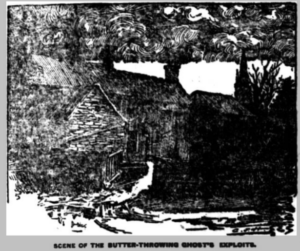
Coed Cernew since January 15 has rejoiced in the presence of a ghost! At least, the local Press has rejoiced, as the incidents furnished the scribes with good copy, but the inhabitants of which this little South Wales village is comprised went about in fear and trembling. Coed Cernew’s ghost was no ordinary spook. Little children saw it and shrieked, grown men and women fled in terror from it, and even the stalwarts of the Monmouthshire Constabulary, nine in number, paled as they stood firm to a man and invited it to “come on.” At least, that is what local gossip said.
The spectre of Mardy Farm differed from the old-time moth-eaten spirit, whose repertoire merely consisted of heavy sighs, plaintive moans, and stately stalking. Coed Cernew’s ghost was modern in every respect – right up to date, in fact. It was at once frolicsome, muscular, and daring, and enjoyed itself as surely no other eerie visitant has ever before done in this cold, showery world of ours.
It first started in business at Mr Parson’s farmhouse, which lies on the right of the narrow, rutty road leading to the stud farm of Lord Tredegar. Mardy Farm is rambling, spacious, and well-built, with just the suggestion of moss growing on its once white walls to give the necessary romance to haunts selected by even a modern phantom. January 15 fell on a Friday – faltal day! Mr and Mrs Parsons that night paid a visit to Newport, five miles away, leaving their children in charge of a servant. The ghost thought it a fitting opportunity to make his presence felt. So he turned all the pictures with their faces to the wall, and presumably chuckled when, from his shady concealment, he noticed the consternation on everybody’s face as soon as the matter was discovered.
The unearthly visitor next proceeded to give manifestations of his muscular development. During the night he took all the unoccupied beds in the place downstairs and left them there. Next morning in broad daylight he is said to have knocked over two hundred pieces of crockery that stood upon the kitchen dresser. Every piece fell upon the floor, yet not a single one was smashed. Wonderful!
One hears of gorgonzola cheese walking at times, but never respectable breakfast bacon. Yet people in Mardy Vale are ready to swear that with their own eyes they saw two huge sides of bacon get off their hooks, slowly slide down the walls, walk around the kitchen, and then calmly betake themselves to their resting place again.
So disturbing were these pranks on the peace of the household that the hamlet assembled as one man and determined to lay that ghost or perish miserably in the attempt. The aid of the village constable was requisitioned, and, headed by the majesty of the law, ten good men and true took up their positions in the farmhouse kitchen, the favourite playground of the spook. The children were sent to bed, and every face grew grim.
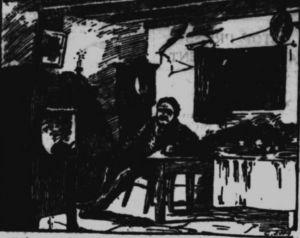
Ten – eleven o’clock! The silence of the night fell heavily upon the solemn council. Nothing occurred. Surely the policeman’s presence had frightened the ghost away. On the mantel-shelf was a timepiece that no human effort could make tick. Long had it lain there idle. Suddenly there was an eerie rustle, and the clock chimes, so long silent, struck the midnight hour. Even the policeman shivered, sceptic though he was. Then a most unghostly thing happened. From an unseen quarter, exactly half a pound of butter flew through space and with an unerring precision which would have made the fortunes of that ghost as a bowler in any All England cricket team, hit the representative of the law full in the eye.
A ghost-drive followed, but although, it is alleged, grim chuckles were heard from time to time, no spook was cornered.
Day by day the ghost went on playing his pranks until the whole countryside was reduced to a state of terror. The contents of pickled cabbage jars were emptied into cream bowls, soda was put into newly-clarified lard, teeth marks were discovered in pieces of butter, and even the hay was taken from the rick and thrown about the yard.
Lord Tredegar, hearing of these things, instituted inquiries, but with no tangible results. The ghost stayed on, rejoicing as an unwelcome guest, devising fresh pranks daily.
Knowing the reports to hand to be on the best authority, and feeling that the Coed Cernew phantom was not acting with the hoary, weird traditions of his kind, two “Weekly Dispatch” representatives journeyed to South Wales to “lay” him. Half an hour’s drive through the beautiful valley, which even the railway track from Newport to Cardiff fails to spoil, and Mardy Farm was reached. Unluckily, Mr Parson was away from home, and Mrs Parson was disinclined to talk. It is no joke to travel 150 miles and to be thwarted at the very threshhold of a mystery. And so the Vicar of Castleton was sought out, and invited to talk about the ghosts.
“I do not believe in ghosts” he smilingly said. “If there are such things they must come either from heaven or hell. A ghost, I take it, would be too happy to leave heaven, and I’m sure they would never be let loose from hell. What has happened is this. An ex-employe of Mr Parsons has been playing pranks, and has undoubtedly frightened children, servants and even the master and mistress of Mardy Farm. The mere fact that the keys of the house are missing points to the conclusion that they are in the possession of some unauthorised person, who enters the house at the dead of night and turns things upside down.”
No far past the 150 mile-post on the Castleton-road is a pretty ivy-clad cottage. It is situate on an eminence, and its inhabitants get a lovely glimpse of the Mardy Vale below the winding road. Here Police-constable 9 M.C. resides with his wife and family. He laughed heartily when the “Dispatch” representative made anxious and even affectionate inquiries regarding the damaged optic. “Things do get distorted,” he said. “What actually happened was this: I heard of all the remarkable things that had taken place at the farm. So I called down. Undoubtedly pictures had been turned face to the wall, and many of the other things you have mentioned did come about, but no ghost did it. It was somebody inside the house – who I am not going to say. Now, do I look like a man a ghost has thrown half a pound of butter at – and more especially hit in the eye? Now, I ask you, am I?”
Police-constable 9 M.C. drew himself up to his full height – 6ft. nothing. Then he squared his shoulders. He certainly did not look like a man with whom even a reckless spook would take liberties. “Don’t forget,” he added, clinching matters, “half a pound of butter weighs something this weather, and there are no marks to show, are there?”
Then the genial constable advised the journalists to pay another visit to Mardy Farm. This was done, but Mr Parsons was still absent from home. Mrs Parsons reluctantly consented to tell the “Dispatch” representative the true story of the spectre.
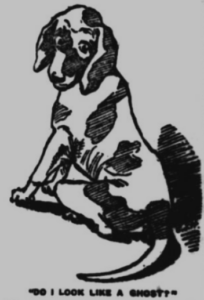
“Mr Parsons and myself went to town that night and left the children at home. When we came back we found them in a state of abject terror, as well as the servant. They said the pictures had been turned to the wall, faces had been seen at the window, and unearthly cries had been heard. We never thought of ghosts, of course, and I imagined the children were merely nervous. So I got very cross. But again the same things and others happened. Then one night we were badly scared ourselves. We heard blood-curdling whining, and in the moonlight we saw a terrible face peering through the window. We rushed outside to find – this old fellow, perched on the window sill, whining for us to let him in.”
“This old fellow” was a very fine brown-and-white French spaniel, and the culprit rubbed his spotted nose in his mistress’s hand affectionately as she spoke, lifting his great eyes up to hers in an appealing glance to her not to show his misdeeds up further.
The exact sequence of the story was supplied by Mr Evan Jones, a farmer of Risca, one of the selected ten who volunteered for ghost-driving. “Naturally enough,” he said, “the Parsons do not wish the ghost stories to go any further. All the gossip, quite contrary to rule, has been absolutely true. They have only partly told you the story. It is quite true that their dog was guilty of alarming them on several occasions. But they omitted to tell you who the person was who shifted the plates, made the clock that would not go strike the hour, shifted beds, lifted bacon off hooks, and did the hundred and one tricks that have been done. I, who know, will tell you, for it is only right that the countryside should know the truth.
“For some time past the Parsons have had in their family a young girl – a relative, I believe – who at times is most extraordinary in her behaviour. Only yesterday this girl, who is about fourteen years of age, was caught in the act of playing a prank with the household goods, which, had it not been detected, would have been attributed to a ghostly visitant. This settled the matter once and for all, and the girl confessed everything.”
So between the dog and the girl the Coed Ciernew “ghost,” which has kept a peaceful South Wales village in a state of turmoil and unrest for a fortnight, has vanished into the thinnest of thin air!
Weekly Dispatch (London), 31st January 1904.
The “ghost” of Mardy farmyard, South Wales, was laid when the tenant of the farm returning late at night saw a mysterious moving light among his hayricks. With two police officers he investigated and James White, watercress seller, of Cantop, Cardiff, was found beneath a lot of loose hay. White, who had several times been convicted for drunkenness and was known to prowl about the district, was sentenced at Newport Police Court to fourteen days’ hard labour.
Evening News (London), 1st November 1904.
(why is this titled in the same way, so long after the incidents? and in a paper so far away?)
Maerdy Farm on contemporary and modern maps.
https://www.geograph.org.uk/photo/439528