Something like a ghost.
People pelted with coal.
Excitement was occasioned in Gravesend on Saturday by the report of an occurrence at 26, Wrotham-road, a street adjoining the Kent County Cricket Ground. The house is occupied by tenement lodgers. Mrs Beadle, one of the tenants, states that as she was sitting in her room in the evening she suddenly saw a “shoal” of cinders fall on the front of her window. Thinking that some of her children had thrown them, she went out, but they told her they had done nothing of the sort. As she was entering the door again she was startled considerably by a heavy lump of coal falling at her feet from upstairs.
Becoming alarmed at this extraordinary state of affairs, she went a neighbour on the matter. He armed himself with a revolver, and accompanied her to the house. He went upstairs to see if any coal was kept in the bedroom, and as he was mounting the first few steps, a lump fell heavily just behind him. This so startled him that he turned and fled.
Mrs Beadle then sought the advice of other persons living in the neighbourhood, who suggested that all the lodgers in the house should leave before anything else happened. One of the sons of Mr John Reed, a ticket collector on the South-Eastern Railway, and who is also a tenant of the house in Wrotham-street, said he would try and find the “ghost”. As soon as he started to go upstairs, however, he was pelted with coal, one nut striking him on the head.
Nothing daunted, the lad called in a couple of companions, but on opening the door leading to the stairs the candle he was carrying suddenly became extinguished. Reed addressed the “ghost” and asked him to throw the rest of the coal if there was any more left. Hardly were the words out of his mouth when a shower of coal was hurled at him, one lump striking him so heavily on the face that he fainted.
Although the house has been thoroughly searched no explanation can be given of the occurrences. Many put the manifestations down to practical joking. Hundreds of people visited the place on Sunday and order was maintained by the police.
Gloucester Citizen, 20th September 1897
The Gravesend Ghost
Rats suggested as the cause of the scare.
But the police attribute it to naughty boys.
A Morning reporter was sent down to Gravesend yesterday to arrest the ghost who had been throwing coal about at a little house in Wrotham-road, occupied by a ticket-collector of the South-Eastern Company. The spook, or whatever he is, commenced operating some days ago, producing by his agency of the spiritual world divers bumps and bangings and shrieks. It was said that the ghost – who by the way nobody has ever seen – had showered cinders and small pieces of Lord Londonderry’s best households on unoffending occupants of the house in Wrotham-road – a little tenement into which no really energetic ghost intent on business, would care to enter. The reporter alightted yesterday afternoon on two perspiring men who were engaged on the removal of the coals – all else had gone, or nearly so.
The one man who surrendered his occupation at once at the suggestion that there was something uncanny about the premises, showed the journalist over the premises. The man was convinced that “there was something in it”; but he could not account for the fact that there were no broken windows and no holes in the roof through which the “nubbles” could have been projected. But he rather pinned himself down to the statement that a boy belonging to the house had fainted in going up to engage the “ghost” in conversation having (as the boy said) been struck by one of the nubbles. He called his mate, mutually engaged in getting up the coal, “What about this ‘ere mystery? – Gen’leman wants to know.” “Well, sir, my idea it’s rats. Yes, rats. After we get out the ghost will do a guy. Don’t yer know that rats carry lumps of coal about with ’em, and whenever they hears a stamp of a foot they drops it? That’s what’s done it. Why, there’s a lot of rat holes down below, and that’s in my opinion where the ghost comes from. No I don’t think we shall be able to clear out altogether to-night.” “Well, then, the ghost will have at least another night for knocking about in the coal cellar.” “Maybe: but he won’t have much left except slack, and nobody to chuck at.”
The reporter then came across the small boy who fainted, and who, with a youthful friend, was vigorously puffing a cigarette. He was insistent as to the spook having hit him with a nugget of coal on the right jaw, just as he was going up to defy the mysterious personage. There was, however, no sign of damage to his outer cuticle; for which he could only account by the interposition of a merciful Providence. To show that there was no deception he produced from the mantelpiece a collection of small coal which he asserverated had been showered upon him. He didn’t say “rats” in parting to the reporter, but went away like the good boy that he seemed to be, smoking his cigarette and attending to the removal of the last part of his father’s effects.
The police have their own opinion of the whole proceedings. They say that “the boys” ought to be well birched. The affair is altogether ridiculed by Gravesend people as the outcome of a juvenile “game at ghosts,” but it comes none the less serious that landlords of houses should be made to suffer for the wicked enterprises of Young England.
South Wales Echo, 21st September 1897.
The Coal-heaving Ghost
Tracking him down
Views at Gravesend
(Daily Chronicle Special).
A ghost that heaves coals about – why not “‘arf bricks”? – promised interest, and so (writes a Chronicle correspondent) I went down to Gravesend yesterday. I cannot say that I captured the ghost, but certainly I had an entertaining time in gathering information about it. You must use the “it” because nothing has been seen of the ghost of No. 26, Wrotham-road, Gravesend – never a whisk of a white frock, not a blink of anything. If you like, this merely gave zest to the mystery, and the pity was that Gravesend should be such a dreadfully prosaic place. If I had been a ghost out on the rampage I should have found some spot with more romantic surroundings.
Now to the items of the story, and first I ought to mention that No. 26, Wrotham-road is now empty – the tenants have left. In it there had dwelt Mr. John Read, a railway servant, his four children, and Mr and Mrs Beadle. I saw Mr Read, and his judgment on the affair may be summed up thus – “Why, we can’t make anything of it. That certain things happened is certain, but attempts to find an explanation for them have been quite unsuccessful. In view of them the children wouldn’t stay in the house – they got very nervous – and I thought it best to move.”
It was on Sunday week, Mr Read went on, that the trouble began. About six o’clock in the evening the children were playing in the little garden which is behind the house. Mrs Beadle, who looks after them, was in the parlor, and as she sat there she heard cinders fall in the passage. “Dear me, those children,” she muttered, and called to them, whereupon there fell more cinders and a substantial lump of coal. The children, however, knew nothing of the visitation, and no explanation of it was at hand.
Mr Read was summoned from his railway duties, a neighbor was called in, and, in fine, the ghost was given every attention. He responded with another chunk of coal, and the family got so scared that they never went to bed on the Sunday night. On Tuesday Walter Read a lad of fifteen, was on the stairs when suddenly more coal came slap down upon his head. He tried the ghost again in the evening, but this time had an even rougher reception. Well, that is the sort of thing that went on, the one variation being a mixture of stones with the coal.
“The strange thing,” Mr Read said to me, “is that the events all happened when Walter was in the house – then, and only then.” “What about Walter’s boy friends,” I asked, “were they playing a trick upon him?” Mr Read didn’t think that clue offered any solution – the missiles seemed to come straight down from the top of the house. Altogether, he summed up, it was an odd and uncanny business, and he just shook his head. He had probed it to the utmost and was as wise at the end as he had been at the beginning.
“I should dearly have loved to see the ghost,” a hardy and froward townsman of Gravesend declared to me. This was precisely my own feeling when I turned into Wrotham-road and trudged along to No. 26. With me I had a companion, who carried a camera, and I felt that if the ghost could only be photographed it would be a great triumph for the end of the nineteenth century. A supernatural creature chucking coal – what a picture, to be sure!
The house is not large – a workingman’s dwelling, you might describe it – and it quite lacks the luxuries which ghosts are supposed to court. It is not even built apart, but on one side has a greengrocer’s shop and on the other the premises of a builder and undertaker. True, the scent of a coffin might have been an attraction to the ghost, only it would have been so easy to find a cemetery.
The front door was shut hard, and the windows were bare, except for a couple of forgotten curtains in the basement. Behind the house, the vision to the eye was one of wooden houses and back yards. “Interested in the ghost, are you?” queried one of the undertaker’s men, adding, “I hope you’ll find him.” “I wish he’d throw some coal this way,” rang out a housewife’s voice from a neighboring garden, “because it would be very useful in the winter.” This was discouraging; it was so unghostly. Half-a-dozen chickens still remained in the back garden of No. 26. They did not even cackle. An open door invited one in quest of the uncanny – an open door from which you had a view of the basement below and the first floor rooms just above. The ghost made no sign, and I gaily swung down the steps to the basement. A dull front kitchen, a small scullery, also dull, looking out to the rear – that, with a patch of coal in a sort of cellar, was the picture. No, I had forgotten several rat holes in the wooden flooring, and rat holes should never be overlooked.
Then I trudged to the first floor – a front room, a back room – and really it presented nothing to write about. Eight steps higher – counting from the front door level – then six steps at right angles, and that brought me to the top of the house. Another front room, a smaller one at the back, and nothing further – never a stick of furniture left for the use of the ghost. He still made no sign – still wait, there was here a little hole in one of the panes of the back window. The staircase window, as I presently noted, was also cracked – cracked, not broken. Had anybody been casting stones from the outside, say when the staircase window was open? My friendly ghost-seeker threw a bit of coal in at the little window, which had slid up quite easily. The coal alighted at the foot of the stair beside me, and a second piece, thrown rather more sharply, danced towards the front door. There is a satisfaction in being able to declare that I was not afraid – nay, I was even disappointed at the persistent absence of the ghost. But was this his track? Perhaps.
Such were my gleanings and experiences anyhow, and you must make what you will of them. A ghost story is always an institution until it is driven out by a fresher story. For myself I have no sympathy with any ghost that would interfere with the hard-working coalheaver. It is not fair – blacklegging of the worst character would be a mild description.
London Daily Chronicle, 21st September 1897.
The Gravesend Ghost
An Australian correspondent suggests that the Gravesend coal-throwing ghost is reminiscent of the “Enmore ghost,” whose similar proclivities created a mystery of several days’ standing in Sydney a few years ago. In the Australian case a certain house received regularly at particular hours of the day a fusilade of stones from no ascertainable source. The scared inhabitants evacuated the house, the Sydney papers sent special reporters to the scene, and the curious flocked to the house in crowds. Some gentlemen of scientific renown examined the mysterious missiles, and one of them learnedly declared that the stones were “of meteoric origin,” while another hazarded the opinion that they emanated from the planet Mars. But there is nothing more obscure than the obvious, as some paradoxical philosopher has observed, and after all the stones were found to have no more mysterious origin than the topmost branches of a tree in the vicinity of the house, whence they were hurled by some mischievous urchins who had secreted themselves there.
Exeter and Plymouth Gazette, 24th September 1897.
At last we hear of a ghost with a practical turn. He has been pelting Mrs Beadle and her family at Gravesend with lumps of coal. Mrs Beadle was alarmed, and a neighbour, though armed with a revolver, incontinently fled. But another visitor, with a praiseworthy commercial instinct, discerned the advantage to the Beadles of a ghost who replenished the family coals from stores which were either supernatural or the property of the lodgers upstairs. So he cheefully invited the ghost to throw down “the rest.” The response was a heavy shower of coal, one lump proving a rather ugly missile. A playful ghost evidently, who ought to be approached in future with an open umbrella. For Mrs Beadle’s sake, we hope nothing will be done to offend him. Jupiter wooed Danae in a shower of gold, but coal will answer the purpose in our less romantic age. It is possible, however, that some of the lodgers may break the charm by mounting guard over their scuttles.
Lincolnshire Chronicle, 24th September 1897.
A Haunted House of To-day.
A Gravesend Ghost.
The inhabitants of Gravesend, like the men of Athens of old, are given to superstition. So one of the oldest inhabitants told a Golden Penny man, and he ought to know. Whether or not this comes from the large proportion of sea-faring folk in the town, sailors being notoriously inclined to the supernatural, the Gravesender did not know. “Yes, sir,” he said, “we are apt to take ghosts for granted down here.” “And what is this latest ghost story of yours?” asked the correspondent. “It’s all in our local paper,” was the reply, and he produced a newspaper cutting as follows: –
No. 26, Wrotham Road, is occupied by seven persons – Mr John Reed (South Eastern Railway official), his four children, and Mr and Mrs Beadle. The first intimation to lead to the supposition that anyone else – natural or supernatural – was present came on Sunday. At six o’clock in the evening Mrs Beadle was sitting in the parlour, and noticed cinders fall in the passage outside. The children were at the time playing in the garden at the rear, and thinking they were flinging the cinders in, Mrs Beadle spoke to them. Still more came, and Mrs Beadle, going out of the room, saw quite a “shoal” come. The children declared they had not thrown anything.
Mrs Beadle then says that she went to the street door and stood for a while, when a big lump of coal fell from upstairs. Neither of the children was near nor in the upper apartments, while we are assured that no coal is kept in the bedrooms. Wondering where the solitary missile could have come from, Mrs Beadle’s next step was to fetch Mr A Reed, a neighbour. He examined the house without any result, and finally Mr John Reed was summoned from the station, but even the two Reeds could not read the riddle. Mr Reed says, however, that he heard something drop while in the house, while Mrs Beadle states that a piece of coal descended at his heels just as he was turning to go. The occupants of the house, it appears, were so frightened that they stopped up till five o’clock and went out on Monday morning, only coming in during the day for meals. “No one has slept at the place since Sunday,” was the effect of Mrs Beadle’s remarks.
Tuesday was the most serious day, and when the ghost was in his most dangerous mood. It appears, from all accounts, to have a special liking, or rather disliking, for Walter Reed, aged fifteen, and has only carried out its pranks when the lad has been within the house. but to go on with the tale. On Tuesday afternoon the boy mounted the stairs for his coat, and about half-way down was struck with a bit of coal about the size of a walnut. In the evening Reed returned with a couple of companions. On opening the door the candle he was carrying blew out. Reed exclaimed, “Now, old man, if you have any more coal, let’s have it,” and no sooner were the words out of his mouth than a piece of coal hit him in the face. He ran back and fainted on the doorstep.
The house is of the most commonplace and uninteresting type of Victorian architecture. The Golden Penny correspondent was struck by one fact. The coal thrown by the ghost was always thrown on the staircase. A brief inspection of the interior showed that the staircase was completely commanded by a window which looked on to the back yard at a very convenient height for just “lobbing” stones through it. The stones or coal could be so thrown as to fall on the stairs and hop down them to the bottom or they could be pitched so as to clear the stairs and fall plump in the passage. And having worked out this little matter by actual experiment, The Golden Penny ghost hunter reflected that in Gravesend as elsewhere “boys will be boys.”
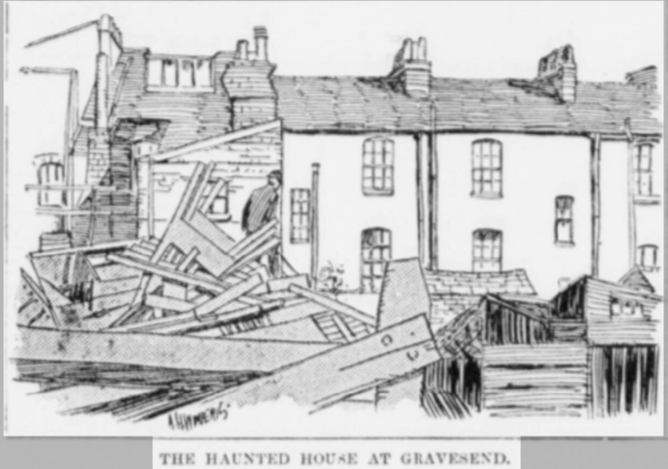
Golden Penny, 16th October 1897.