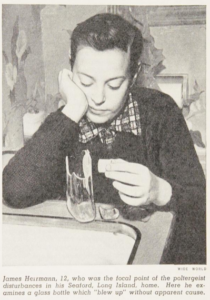
Photograph from the Colliers Encyclopedia 1959 Year Book.’
Poltergeists. Seaford Poltergeist Case.
On Feb. 3, 1958, a series of unusual events began in the home of Mr and Mrs James M. Hermann of Seaford, Long Island, N.Y., which aroused widespread public interest as a result of a barrage of newspaper stories, radio and television programs, and scientific articles. Although descriptive of but one kind of phenomenon that occurred, the name “Bottle Popping Case” was used by headline writers to identify the Seaford disturbances. A more generally descriptive title, “The Seaford Poltergeist Case,” was also employed. The term “poltergeist” means literally in German, uproar + spirit – an alleged spirit or ghost-like agency supposed to be responsible for the production of diverse phenomena such as mysterious noises (often in the form of rappings), the flight of objects, the destruction of household articles, and the general harassment of human beings without the “normal” participation of “natural” agencies.
The disturbances in the Herrmann household included most of the standard phenomena associated with poltergeist cases and, in addition, what appears to be one unique feature, the removal of the screw-on type caps from various bottles with the subsequent spillage of their contents.
The Hermann family, consisting of Mr anad Mrs James M. Herrmann, their son James (age 12), and daughter Lucille (age 13), was extremely cooperative in allowing parapsychologists (investigators of psychical phenomena), and others, to carry out investigations in their home and, as a consequence, several parapsychologists later published evaluations of the Seaford disturbances.
Duke University Investigators’ Evaluation. The most complete of these accounts is that of J.G. Pratt and W. G. Roll of Duke University (Journal of Parapsychology, June 1958), who listed the 67 events constituting the Seaford series. They indicate, from the point of view of parapsychical import, that the three classes of events which were of most interest are: “1. Those in which someone saw an object move without apparent physical means of propulsion. There are four events in this group. 2. Those in which some unseen occurrence took place when no one was near enough to have caused the disturbance or had any discoverable means of doing it from a distance. There are thirteen events in this category. 3. The five events which occurred when one or both of the Duke investigators were present. (Two of these also belong in the second category.)”
As an example of a disturbance in the first category, Pratt and Roll provide the following entry from the police record made shortly after the event: “Mr Herrmann standing in the bathroom doorway, son James at sink brushing teeth, actually saw a bottle of Kaopectate move along the formica top of the drain in a southerly direction for about 18″ and fall into the sink. At the same time a bottle of shampoo moved along the formica drain in a westerly direction and fell to the floor. There was no noise or vibraation and no one touched either bottle to move them.”
After indicating that they found no evidence to support the validity of three types of non-parapsychical causes – fraud, psychological aberration, and normal physical causes – as explanation of the Seaford events, Pratt and Roll present the following summary evaluation: “… if the Seaford disturbances are not fraaudulent – and no evidence of fraud was found – they clearly make a proper claim upon the interest of parapsychologists.
“It must be kept in mind that the investigations as conducted to date rank as exploratory rather than as conclusive. There was no disturbance which the investigators could observe under conditions as good as those that can be produced in the laboratory… But science consists of more than reaching conclusions. One of its important functions is the appraisal of problems that might justify further study. The investigation of data bearing upon a problem that needs clarification is an indispensable link in the chain of scientific progress. The observations which suggest the occurrence of RSPK (recurrent spontaneous psychokinesis) present such a problem, and the Seaford case may come closer than any other in supplying the necessary link.”
Pratt and Roll thus appear to be somewhat acceptant of the view that the Seaford disturbances may be “paranormal” in nature.
A Contrasting Evaluation. The contrasting view of Karlis Osis (Newsletter of the Parapsychology Foundation, Inc., March-April 1958) may be cited. After an analysis of the nature, time, and place of the disturbances and a parallel analysis of the location of the members of the household when the events occurred, Otis presents the following conclusions: “(1) The phenomena were not explainable by the hypothesis of unguided physical forces. (2) The presence of James Herrmann, Jr., in all likelihood, was a anecessary condition for the occurrence of the phenomena. There was a close relationship between his activities, habits, and whereabouts and the distribution of the disturbances. (3) Two hypotheses were carefully considered: (a) The ‘Normal’ Hypothesis: James, Jr., might have caused the events by normal means. (b) The ‘Paranormal’ Hypothesis: James, Jr., might be the paranormal cause of the events by means of telekinesis. (4) The ‘Normal’ Hypothesis was found to be sufficient to explain virtually every reported disturbance. (5) There were a number of observations which were easily explainable by the ‘Normal’ Hypothesis, but rather awkward when considered under the ‘Paranormal’ Hypothesis. (6) The ‘Paranormal’ Hypothesis was not substantiated by the facts.
“In general terms: We have strong enough evidence that the boy might have caused the disturbances by normal means if he so wished. This gives us sufficient grounds upon which to reject the paranormal explanation.”
Colliers Encyclopedia 1959 Year Book.
Flying crockery – ‘it’s magnetism’.
After spending 24 hours in the house of “flying furniture” at Seaford, New York State, an observer says he believes he may have solved the mystery. His solution: Two underground streams meet under the home and have set up a magnetic field that passes through the house. For three weeks sugar bowls are reported to have moved by themselves and several other items of crockery and furniture are said to have broken or moved. – B.U.P.
Manchester Evening News, 28th February 1958.
Family plagued by “flying furniture”.
Dr. Gaither Pratt, Director of the Parapsychology Laboratory at Duke University New York, has been called in to study the mystery of the flying objects in the home of Mr. and Mrs. James Hermann. More than three weeks ago, the Hermanns reported that they began to be plagued by bottles which mysterious became uncapped, overturned, spilled, and even flew through the air.
The latest occurrences involved weighty objects like a record player, said to have flown ten feet through the air and crashed against a shelf, and a large world globe which travelled from one room into another. Upset by the unexplained happenings, and beseiged by reporters, photographers and police, the family which includes two children, has now left to stay with relatives.
Hartlepool Northern Daily Mail, 7th March 1958.
Priest Blessed House of Strange Events.
Seaford, N.Y., March 4 (NC).
A priest who blessed the house here where a series of reportedly inexplicable events have taken place said he can offer non explanation. Father William J. McCloud of St. William the Abbot Church said he visited the home of Mr and Mrs James M. Hermann, members of the parish, at the family’s request. “I went out there February 11 and blessed the house. This was about a week after the strange events were said to have begun. Mrs Hermann told me that things were normal for two days after my visit, but that after that time, it all started again,” Father McCloud said.
The Hermanns have reported that since February 3 the mysterious happenings in their house have included the unscrewing and popping of bottle caps and the hurling of appliances and other articles by an “unknown force.”
Father McCloud, a priest from Edmonton, Alta., who is helping out at this Long Island parish, said many persons who have visited the home and seen the apparent results of the unknown force have volunteered that the force is a poltergeist – “a mischievous, unnatural force of some kind known to man for centuries.” Among the group – including newsmen and police officials – investigating the reported happenings was Dr. J. Gaither Pratt, a psychologist from Duke University’s Parapsychology Laboratory. He said the laboratory studies “nonphysical factors of man as they apply to telepathy, clairvoyance, precognition and the power of the mind to affect the behaviour of matter.”
The Catholic Northwest Progress, 7th March 1958.
John Gold cables this week’s spookiest story.
Do I believe in ghosts? Well I’m not so sure now…
New York, Thursday.
I spent last evening in New York’s “haunted house” and – so help me – the “ghost” walked. Within the space of half an hour I – Saw an object fly clear across an empty room and strike a wall; Heard a heavy flower bowl crash into a corner cupboard in another room; Listened to a large bookcase clatter to the ground in the apparently unoccupied section of the basement.
The scene of all this disturbance, number 1,638, Redwood Path, Seaford, Long Island, is a typical American suburban house, hardly the sort of home you would choose for a poltergeist. Inside and out there is little to distinguish it from the scores of other homes on the new estate. Nor is there much to distinguish its occupants – the Herrmanns – from their suburban neighbours. Mr Herrmann, tall, dark, in his early forties, regularly catches the early train for the 35-miles journey to his office in the city. His brunette wife Lucille, who was once a nurse, now stays at home to take care of their two children, James, aged 12, and Lucille, aged 13.
The police assigned a detective to the case of the Herrmann house. But the luckless detective was no more successful in laying the persistent ghost than had been a team of building inspectors, several electricians, a priest, a university psychologist and a water diviner, all of whom tried. Then I had my chance. Mrs Herrmann stepped into the kitchen to fetch me a cup of coffee. From the basement playroom the noisy beat of rock ‘n roll was coming from James’s radio. Sunlight was still streaming in through the windows. No house ever seemed less haunted.
Suddenly, as I looked into the empty living-room from my seat in the dinette, a photographic flash bulb which had been standing on a table just out of sight sailed 12ft across the room, hit a wall, ricocheted against a curtain, and fell to the floor. WHERE WAS JAMES? When he spoke to us seconds later he was in the basement. Then there was a crash in the dinette. When we reached the room the flower bowl, which had stood on the dining table, lay in a corner. WHERE WAS JAMES? When he spoke to us seconds later he was in the bathroom.
Mrs Herrmann went to call the police. As she did so there was another deafening crash, this time from the basement. A loaded bookcase, weighing more than a hundred-weight, had toppled over on its face. WHERE WAS JAMES? When he spoke to us seconds later he was in another room. Detective Tozzi, a little balding dark-haired man, called and took down a full report of the evening’s events. He filed it away in a briefcase containing a catalogue of similar happenings covering 110 pages.
For weeks past in the Hermann household tops have been flying off bottles and self-propelled objects, including a gramophone, a sugar bowl, a school globe, dishes, several statuettes and a Madonna have crashed against walls and smashed. Said Mrs Herrmann: “Ghosts? Somehow I still find it pretty difficult to believe in ghosts. But I am not sure… I have been getting quite an education recently.”
Manchester Evening News, 6th March 1958.
Junior Observer.
When the sugar bowl took off and hit the floor.
I hope none of you are of a nervous disposition because, this week, I want to tell you a true story about poltergeists. It is taken from an excellent book entitled “Poltergeists: Hauntings and the Haunted” by David G. Knight and it is called “The Seaford Disturbances.” So if you are ready, read on…
Poltergeists can affect anyone, anywhere, but probably the last place anyone expected a full-blown invasion was James Herrmann’s modest six-room house in suburban Seaford, Long Island, America. Yet this quiet home turned out to be the scene of perhaps the best-known of all modern poltergeist disturbances. In all, there were 67 separate events and they took place in 1958, lasting a little more than a month. The phenomena began on Monday, February 3, of that year, at 3.30 p.m. The two Herrmann children, 12-year-old James Junior and 13-year-old Lucille, had just come home from school. Jimmy went upstairs to his room and discovered that a ceramic doll and a plastic ship model on his dresser were broken, it looked as if the doll had somehow smashed against the model. Puzzled, Jimmy reported the damage to his mother, who then searched the other rooms. She found that a small bottle of holy water was lying on its side, the cap off and the water running, on her dresser.
Up to this time, no noise had been heard, but during the next 45 minutes, a series of bottle-poppings was heard in various parts of the house. In the bathroom, kitchen and cellar, bottles were found lying on their side with the liquid running all over the floor. In the cellar, Jimmy and his mother actually saw a half-gallon bottle of bleach sail halfway across the basement and smash against the wall. When Mrs Herrmann told her husband, he left his job and rushed home. He thought some chemical reaction had forced the bottles to open but when he examined them, it seemed impossible that this could have happened without the neck shattering as well – and all the necks of the bottles were intact. Plus, the tops were the screw-on type which required a number of turns before they could be removed.
This was only the start of the Herrmann’s troubles. That Thursday, almost the same thing happened at the same time, and on Friday, Jimmy was alone in the house when the cap on a bottle of ammonia in the cabinet under the sink became unscrewed and the liquid spilled. Mr Herrmann actually suspected young Jimmy might be the culprit, but, on Sunday, when nine separate incidents took place, Jimmy was in the room with the rest of the family. Still not convinced, however, Herrmann confronted his son at the door of the bathroom. Jimmy, still at the sink, kept protesting he had nothing to do with the bottle-poppings. On a formica table between them, stood two bottles of shampoo which had spilled just a few minutes before; as Herrmann and Jimmy talked, the father was astonished to see both bottles begin to move. He later testified that Jimmy “froze” where he was and it was this incident that really convinced Herrmann that something really unusual was going on.
He went directly to the phone and called the Nassau County Police Department. Although they regarded it as a wild tale, an officer was sent to investigate. Patrolman James Hughes arrived at th ehouse and he didn’t have long to wait for the poltergeist action. He was sitting in the living room with the entire family when a noise was heard in the bathroom. Hughes, who had already inspected the bathroom, was amazed to find that the bottle of shampoo, which he had seen standing on the table, had overturned.
Three days later, the bottle of holy water was again found upturned. But this time, as Lucille cleared up the water, she found it warm to the touch. That same evening, a little before 8 pm, the poltergeist activity took a more exciting turn. Mrs Herrmann’s cousin, Marie Murtha, was watching television with the children when she saw a porcelain figure on the end table begin to “wiggle… like a worm cut in pieces.” It flew up into the air then crashed onto the rug unbroken.
The incidents went on – five events took place on Sunday including Jimmy’s night lamp being knocked to the floor and the bulb broken, and two disturbances during the first part of the next week. All this while, police were trying to figure out some physical cause for the disturbances. Thinking they might be caused by high-frequency radio waves they even questioned a man in the area who had a “ham” radio licence but it turned out he had not used his set for years. A lighting company was summoned to check the house’s wiring, fuse panels, and ground cables for possible faulty electrical emissions, but everything was in order.
And the disturbances got worse. A sugar bowl took off from the dining room table and struck the floor – this happened while detectives were there; an ink bottle lost its screw cap and sailed toward the front door spilling ink on the chair, floor and wallpaper. The police got a call from a woman who said she had experienced similar type of trouble but it had disappeared when a turbine-type chimney cap had been installed to prevent heavy wind downdrafts into the fireplace. The same thing was installed in the Herrmann’s home but no sooner had they completed the job than the phenomena began again.
Eventually the poltergeist became braver and started moving things like heavy bookcases and dressers. At one time, the bookcase was found tightly wedged upside down between the radiator and the bed in Jimmy’s room. Then, mysteriously, all major disturbances suddenly ceased for three days and theories ranging from changes in the water level below ground causing the disturbances, to checking to see if any correlation could be found between the take offs of jet aircraft and the incidents – but to no avail. Everything around the house seemed to be in order.
During the late afternoon and evening of Sunday, March 2, a series of fresh incidents broke out. Even when the children were put to bed, more things happened in the unhappy household. Loud crashes from Jimmy’s room revealed that the picture over his bed had fallen to the floor. Later another crash brought Mr Herrmann to his son’s room again, in time to see the night table twist about 90 degrees and topple over. Any doubts Herrmann might have had about his son’s guilt vanished when he switched on th elight and found how frightened Jimmy was.
Two parapsychologists, who had been in and out of the house for days during the manifestations, were both present during the finale of the case. On Sunday, March 9, both children were in bed and one of the researchers was talking to Mr Herrmann in the dining room when they heard an enormous thump from the direction of the boy’s room. A search was made but nothing was found. About 45 minutes later the same thing happened, but, again, nothing was found. Yet the sound could not be reproduced by striking various walls – the researchers tried but failed to get the correct tone. The next evening the poppers were at it again and bottles all over th ehouse spilled their contents. But then, as suddenly as it began, the disturbances ended.
Years later, Mr Herrmann was quoted as believing a new theory. He was reportedly convinced that some kind of radio ray from a submarine navigation station off the coast had somehow caused the phenomena, but he admitted: “Whenever I hear a creak, I don’t always tell the wife about it. But, even now, I’m not completely sure that it’s over.” The parapsychologists, however, dismissed the submarine theory. Having ruled out fraud, psychological aberrations, and purely physical causes, they decided poltergeists were the only answer.
What do you think?
Compiled by Georgie Murray.
Ballymena Observer, 16th April 1981.
https://archive.org/details/paranth_vol4no1a/page/n41/mode/2up?q=poltergeist+seaford